Showing posts with label June 4. Show all posts

Saturday, 23 April 2022

Controversial Art Taken Down at M+


Comparison of Leung's photo with Wang's work


Still jet lagged and haven't thought of a new blog yet so we will continue on here!

Two disappointing things have happened recently that demonstrate the ongoing deteriorating situation in Hong Kong.

Vidler's firm stops operations on June 3 this year
First is that well known law firm Vidler & Co which handled many human rights cases as well as the 2019 protests, will cease operations from June 3. The announcement was made by the Law Society of Hong Kong, notifying its members of the firm's imminent closure after 19 years.

Senior partner Michael Vidler has not commented publicly about the announcement.

The firm has represented such activists as Joshua Wong Chi-fung, and worked on cases like Indonesian journalist Veby Mega Indah, who lost an eye after a police projectile allegedly hit her on September 29, 2019. While Vidler & Co filed an application in the High Court in December that year to reveal the identity of the shooter, Vidler told Ming Pao in February the following year that the firm did not represent her anymore.

Vidler represented Veby Mega Indah in 2019
Another case the firm worked on was a woman who was allegedly raped in the Tsuen Wan Police Station. Then police chief Chris Tang Ping-keung claimed the case was an attempt to "mislead the police", alleging the claim was not consistent with the video evidence.

Legal representatives of Vidler & Co hit back, claiming Tang was trying to "publicly discredit" the woman.  

The firm is also known for being involved in LGBTQ cases.

Interesting to note Vidler & Co will be closing the day before the 33rd anniversary of June 4... coincidence?

Also along the same vein, contemporary art museum M+ has reopened, months after the fifth wave began in late December. The new head of M+, Bernard Chan toured the museum on April 21 and notably three works were replaced that were related to Tiananmen.

Wang Guangyi's portrait of Mao
One is Wang Xingwei's New Beijing, painted in 2001 showing two injured penguins on the back of a makeshift tricycle flatbed. It is a riff off of photographer Leung Heung-shing's photograph of a man trying to cycle as fast as he can to take two victims to the hospital.

Another piece is Wang Guangyi's Mao Zedong: Red Grid No. 2 (1989), showing a painted portrait of the Great Helmsman, though with a red grid painted on top as if the leader is in a cage.

Finally, Zhou Tie-hai's Press Conference III (1996) refers to the Cold War. These works are now probably stuck in the museum's gulag, never to be seen in person again, though they can be found online on the M+ website.

M+ response?

"It has always been M+'s plan to rotate over 200 artworks in the first year after its opening," a statement read. "Nine out of over 200 have been rotated before reopening, in particular those which are in greater need for conservation."

Controversial artist Ai Weiwei's work Whitewash, featuring old jars that have been repainted is still there, though the black and white photograph of him giving the middle finger to the Gate of Heavenly Peace across from Tiananmen Square is not available...

This Ai Weiwei photo is not shown at M+
In any event, we can't help but be amused that pro-Beijing stalwarts who are staunchly behind chief executive candidate John Lee Ka-chiu, are angry that their star nominee cannot post his campaign videos on the YouTube video-sharing platform because the company needs to comply with US sanctions against him.

Lee called the sanctions "unreasonable",  a "bullying act" and a means to "exert pressure to make him have hesitations" regarding the upcoming election.

"Any country's official should strive for the best to defend their country's national security," he said. "Their unreasonable act will just strengthen my belief that what I am doing is right."

We hope Lee knows what he is doing because he is also getting a lot of ridicule for the copywriting on his campaign materials. A social media group has criticised the choice of words and grammar in Chinese and English, pointing them out much like a teacher does with a nasty red pen.

Perhaps even more entertaining is that Lee's campaign team actually follow many of these correction suggestions.

All for the greater good, right?


Monday, 4 April 2022

Lam said today she would not run again for chief executive

After five years, Carrie Lam Cheng Yuet-ngor has thrown in the towel. Today she announced she would not seek a second term, and will retire.

"I will not run in the sixth chief executive elections," Lam said. "In other words, I will complete my five-year chief executive term on June 30, and will officially end my 42-year career in government."

Twitter went nuts as soon as she made this statement, ending years of speculation if she would or wouldn't try to extend her term. In the end she cited family reasons for stepping down.

Lam victorious on election day in 2017
"They all thought it was time for me to come home," she said.

What is Lam going to do? She is a self-professed workaholic who is known for micromanaging. Maybe she'll spend the next few months counting all the cash she had stashed around Government House but after that, then what? Knitting? Gardening? Hard to imagine her being a homebody.

But it is a relief to know she will not be continuing as Chief Executive, but at the same time, the next leader will be just as hamstrung by Beijing.

Her time as chief executive has definitely left Hong Kong worse off than how it was five years ago. Most memorably was her proposal of the extradition bill in 2019 which led to millions of people protesting in the streets.

She did not heed her own election promise to step down if she did not have the support of the people. Instead the police were unleashed in a bid to quell the protests which resulted in many residents' hatred of the authorities which led to some violent clashes and the horrific attacks at the Yuen Long MTR station on July 21, 2019, and also in Prince Edward MTR station on August 31 that year.

Extradition bill sparked millions into the streets
None of these incidents were ever fully investigated or the police held accountable for their actions.

A year later Lam brought in the national security law, and that sparked another upheaval. Over 10,000 people were arrested, including lawmakers, activists, and students. Then Apple Daily was shut down, with owner Jimmy Lai Chee-ying arrested, and other pro-democracy media or outlets critical of the government closed down out of fear.

Civil society groups and unions also shuttered, either because of threats from the national security bureau or not wanting to have trouble.

Events like the candlelight vigil on June 4 that were commemorated for 30 years were suddenly considered illegal, and even the statue that memorialised it was taken down in pieces and taken away. Any slogans related to it were literally whitewashed.

And then the coronavirus pandemic erupted in Wuhan in January 2020 and soon made its way to Hong Kong.

Police seemed to collude with men in white shirts
At first Lam's administration was praised for managing to keep the virus out of the city, but two years in, fatigue started to set in, people tired of the social-distancing restrictions that seemed more political than scientific. How come playgrounds, sports grounds and beaches are shut when people should really be exercising outdoors and improving their mental health?

Even though Lam said she told Beijing she would not seek re-election, this fifth wave has done her in, being several steps behind Omicron and not being more insistent on vaccinating the elderly, which led to some 200 deaths a day, and over 50,000 cases for a few days.

Today there are 3,138 cases and less than 100 deaths, but not without the government continuing to insist mass testing will be held at some point, anti-epidemic kits being distributed, and such strict social-distancing measures that many sectors like restaurants, gyms, salons, and entertainment venues are in the verge of closing or have already shut, unable to financially sustain themselves.

And not to mention eliminating all opposition from the Legislative Council so that Hong Kong is governed by patriots.

Lam was caught flatfooted in fifth wave
Lam has completely and irrevocably changed the city for the worse -- even the pro-Beijing camp would agree. The next leader, while having an easy ride in Legco, will have a formidable task of reigniting Hong Kong's economy, though it will never be what it was like before 2019.

The sixth CE will have to drag the city closer to the mainland through the Greater Bay Area, but are Hongkongers ready for this? Is there even a game plan?

In the meantime Hongkongers cannot wait to see Lam finish her term in a few months. Where she will reside during her retirement is now up for speculation. Can she even stay in Hong Kong afterwards? Maybe she should pick up knitting and gardening after all...


Saturday, 29 January 2022

June 4 Remembrances Wiped Out at HKU

Workers board up the bridge where a slogan is on the pavement

Following the dismantling of the Pillar of Shame just over a month ago, the University of Hong Kong continues to dismantle all remembrances of Tiananmen Square from the campus, as workers blocked off part of a bridge where students paint calligraphic commemorations of the 1989 crackdown every year.

On Swire Bridge the slogan says: "Souls of martyrs shall forever linger despite the brutal massacre; Spark of democracy shall forever glow for the demise of evils".

Students used to repaint the characters annually
But today nine construction workers wearing helmets and masks (to make them less identifiable) erected a metal partition in the morning to cordon off the part of the pavement on Swire Bridge where the commemorative messages were written.

The bridge is located off its namesake Swire Hall, a student dormitory.

Every year up until last June 11, 2021, representatives from HKU's student union have painted messages on the bridge's pavement to mark the anniversary of June 4, 1989.

In response to media inquiries about blocking off the bridge, a university spokesman said HKU "regularly conducts maintenance works at various locations and facilities", including the bridge.

Not like this before...

The slogan was a reminder of June 4, 1989
Jason Wong Ching-hin, an elected council representative for undergraduates at HKU, said the move was regrettable, saying that students and teachers have been repainting the pavement for the past 20 years to remind people about the history.

"The move by the university is incompatible with its role to uphold freedom of speech," he said, adding that he feared the university might no longer allow discussions on the crackdown and other sensitive topics in the future.

Along with repainting the pavement, students would annually clean the Pillar of Shame sculpture. 

As university officials in Hong Kong drag the institutions closer to Beijing's preferences, the further they move from freedoms of speech, expression, information and press. 

What would Sun say about HK?
Every time I walk past Dr Sun Yat Sen Memorial Park and see his statue in the middle of the grassy area, I wonder what he would think of Hong Kong now.

In 1887 he had studied at the Hong Kong College of Medicine for Chinese -- the forerunner of HKU -- and wondered what he would think about his alma mater's latest actions...


Thursday, 23 December 2021

HKU Removes the Pillar of Shame

Workers move a piece of the sculpture overnight on Thursday

Two months after heads of the University of Hong Kong ordered the Tiananmen-themed sculpture Pillar of Shame removed, late last night it was taken apart in pieces which were wrapped up and then moved to HKU's Kadoorie Centre in Yuen Long, 30km away.

The surreptitious incident happened after 10pm when yellow plastic barricades were placed around the statue by Danish artist Jens Galschiot and workers in yellow hard hats began dismantling it around 3am, and bundled the pieces into a container truck which left the campus at 6.50am.

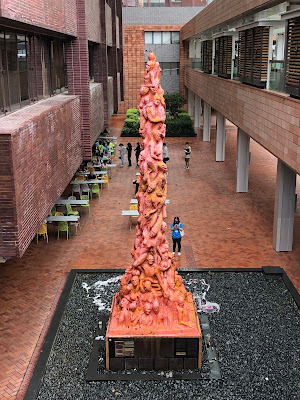
The Pillar of Shame originally looked like this
The HKU Council confirmed the removal of the eight-metre tall sculpture in a statement after the deed was done, saying the decision to take down the Pillar of Shame was made in light of "external legal advice and risk assessment" after a meeting on Wednesday.

"Latest legal advice given to the university cautioned that the continued display of the statue would pose legal risks... based on the Crimes Ordinance enacted under the Hong Kong colonial government," the statement said.

So it's not national security law related? Or any other law not related to NSL?

The council also said it was "very concerned about the potential safety issues resulting from the fragile statue" and noted that no official approval had ever been granted for its display. It had stood on campus since June 1997.

While the statement didn't give specifics on the potential legal risks, Section 10 of the Crimes Ordinance deals with acts with a seditious intent, including publications and displays of any seditious material, deemed a crime punishable by up to two years in prison and a HK$5,000 (US$641) fine for a first offence.

The artist is threatening compensation for damage
At Wednesday's council meeting, a large majority of the members -- most of whom are external stakeholders -- voted for the statue's removal.

It seems the council was prepared to remove the statue immediately after the meeting without asking other stakeholders on campus. This drew a lot of criticism not only the act of removing the sculpture, but also how it was done.

Legal scholar Eric Cheung Tat-ming said he could not see the rationale for citing Section 10 of the Crimes Ordinance to remove the pillar.

"The section has existed for a very long time and the statue was erected at HKU for years. Why did they not think the display had a [seditious] intention in the past, while suddenly they think it will violate the law?" Cheung said.

Indeed. We are all wondering the same thing.

And many critics have also pointed out for the university to take it apart in the middle of the night days before Christmas shows how cowardly the institution is in dealing with the issue. 

Interestingly the statue's removal comes two days before council chairman Arthur Li Kwok-cheung ends his term, and is days after the recent Legislative Council election to ensure "only patriots" hold power.

The statue was moved to Yuen Long
Li claimed on Sunday that it was still unclear who was the rightful owner of the sculpture, but artist Galschiot said Thursday it was his and accused the university of "destroying" the art work, and had ignored his offer to travel to Hong Kong to take it away.

"[HKU] will not talk to me," he said in a statement. "Countries around the world have offered to receive the Pillar of Shame, and the Danish foreign minister has offered his help -- but there has been no response from [HKU] or other responsible authorities."

He added: "It is my private property and the sculpture belongs to me personally... I will claim compensation for any damage to the sculpture. It is a disgrace and an abuse and shows that Hong Kong has become a brutal place without laws and regulations such as protecting the population, the arts and private property.

"And it's even more grotesque that they use the Western holiday Christmas to carry out the destruction of the artwork."

The aftermath of the removal is empty space
What is left is the yellow plastic hoarding and white plastic sheets over the area where the pillar was. Around the hoarding are pots of poinsettias as if to give the space a festive air.

The university has taken a hard line on the statue, which sparks questions around the future of freedom of speech and expression, as well as academic freedom on campus. More importantly it shows HKU complicit in following the government's lead in removing any reminders of what happened on June 4, 1989.

Will students there wish to continue studying at HKU following this incident? How do the alumnae feel?And what does this mean in terms of remembering Tiananmen? Will students and staff still be able to commemorate it in some way? Can the topic still be taught in class?

While administrators may think they are doing the right thing, they are destroying the foundations of the university, and Hong Kong too.

Wednesday, 17 November 2021

Lee Cheuk-yan Stands by His Beliefs Despite Jail


Lee says he will never forget what happened in Beijing 1989

There are numerous court cases going on simultaneously, making people lose track of who is on trial, who has been convicted and who is in jail, though most people related to the anti-government protests or the national security law are remanded in custody.

One of them is former lawmaker and chairman of the Hong Kong Alliance in Support of Patriotic Democratic Movements of China Lee Cheuk-yan, who pleaded guilty to inciting others to join an unauthorized assembly at Victoria Park for the June 4 candlelight vigil.

Some people defied the police to hold a vigil
Today he gave an emotional mitigating speech in court to explain why he continued to mark the anniversary.

He explained the alliance was set up to support the democratic movement in Beijing, where students gathered in Tiananmen Square. A group of them arrived on May 30, 1989, but a few days later on June 4, he says he "heard incessant gunshots and reports that the tanks were entering, bloodily crushing protesters in Chang'an Avenue".

The next morning he recalled seeing the casualties carted away. "We had no idea how many were hurt and killed. It was a night of immense devastation that I can never forget," he wrote.

Lee tried to board a plane going back to Hong Kong, but was stopped by the police and interrogated for three days. Luckily, he says, Hongkongers petitioned for his release and he came back on June 8.

Lee was in Beijing when the massacre happened 
"I thanked God in my prayers, dedicated myself to be His instrument of Justice, and committed my life to the struggle for democracy to Hong Kong and China. This is my pledge to the people of Hong Kong who rescued me and the people of Beijing who implored us to tell the truth of what happened in the Square to the world. Since then I have always engaged in the mission of the Hong Kong Alliance and attended the June Fourth candlelight vigil every year until this. In prison I continued to honour their memory by fasting for a day and by a lit match."

Later in the speech he points out that the authorities have threatened freedom of expression and assembly, and that they are depriving inmates the right to access to information, such as books, magazines and daily necessities. 

He says HK people will not forget 1989
He also observes the irony in the Hong Kong police upholding Mahatma Gandhi and his non-violent struggle, when he was actually a pioneer in civil disobedience.

"If the Police endorses the non-violent struggle led by Gandhi, why should it not respect the right of the people of Hong Kong to honour the memory of the June Fourth Massacre through a peaceful, non-violent assembly?" he asks.

Finally Lee ends his speech, saying: "If I must go to jail to affirm my will, then so be it." Applause and cheers were heard in the courtroom.


Sunday, 14 November 2021

M+ Finally but Cautiously Opens


M+ is designed by Herzog & de Meuron, at least HK$760M

A few days ago M+ finally opened on Friday, though with cautious fanfare.

First some impressive stats. The Museum of visual culture is designed like an upside down T, nearly twice the size of the Tate Modern with 17,000 square metres (183,000 sq ft) of space in which to display 1,500 works from its 6,413 pieces. M+ cost at least HK$760 million to build, and several years behind schedule, which resulted in bad timing.

Before M+ opened its doors, the national security law was implemented, coupled with numerous pro-democracy activists thrown in jail, a liberal newspaper shut down, and the city's electoral system completely revamped so that only "patriots" can run. As a result the contemporary art museum is treading on dangerous territory.

Tang said the art must comply with the law


Art is supposed to be an extension of freedom of expression... is it not?

"We will uphold and encourage the freedom of artistic expression and creativity. But on the other hand, our dedicated curatorial team will ensure the exhibitions comply with the law, including the Basic Law, the national security law, and all other laws in Hong Kong. The opening of M+ does not mean artistic expression is above the law. It is not," said West Kowloon Cultural District chairman Henry Tang Ying-yen.

So yes, by all means be expressive with art -- as long as it complies with the law.

Passive aggressive with legal characteristics.

Ai's Whitewash is displayed prominently
In March, pro-Beijing lawmaker Eunice Yung Hoi-yan tried to score patriotic brownie points by accusing the M+ collection of spreading "hatred" against China, using the example of Ai Weiwei's photograph of him raising his middle finger at Tiananmen Square.

However, did she realize that Ai also has a series of photographs called Studies of Perspectives, pointing his middle finger at other government buildings and famous landmarks around the world too, including the Eiffel Tower, Hong Kong island, St Mark's Square, the Sydney Opera House, and the White House?

Nevertheless, M+ removed Ai's photograph from its online archive, citing a legal review, though his other work called Whitewash (1995-2000) is on show, featuring 126 ancient jars neatly arranged some painted in white, as if to whitewash history.

Wang's painting refers to Tiananmen Square
And then there is a reference to June 4, 1989 with Wang Xinwei's New Beijing. It's a painting of a photograph reminiscent of a man pushing his bicycle with a makeshift board that should be carrying two bloodied people but instead there is a pair of penguins wounded in the chest.

It's also interesting it has featured the works of local artist Kacey Wong, including photographs and sculpture, including his floating apartment idea as a way to tackle Hong Kong's housing crisis. Wong recently went into self-imposed exile to Taiwan, worried about continuing to live in Hong Kong. He wrote on Twitter how cool it was to be able to see his work in the museum through smartphone technology.

Wong's floating home is on show at M+
Many people I know have already had a preview of M+, posting pictures all over social media so I feel like I've already seen half the museum already. But of course it's not the same as being there and interacting with the art in person which I hope to do soon.

But the hopes that M+ was going to display art that couldn't be in China are dashed. Going forward it's going to be a perilous journey for the museum when it comes to art and politics,
whether it likes it or not.


Sunday, 10 October 2021

Pillar of Contention

Looking down at the Pillar of Shame in HKU

Early this morning Tropical Storm Lionrock finally left after 22 hours, the longest a typhoon has lingered since 1978. The Hong Kong Observatory lowered the signal to T3 and then by afternoon all signals were cancelled.

At lunchtime I went to the University of Hong Kong to see for the first and possibly the last time, the sculpture Pillar of Shame by Danish artist Jens Galschiot, commemorating the victims of the Tiananmen Square massacre.

Closeup of Galschiot's sculpture
The university's management has sent a letter via its lawyers to the Hong Kong Alliance in Support of Patriotic Democratic Movements of China to remove the statue by Wednesday October 13 at 5pm or it will be deemed abandoned.

However Galschiot has weighed in on the situation, saying if the university's management damages the statue, he will seek compensation for it.

He said the statue is not for them to throw away as there was no purchase contract nor any payment made, so in principle the statue belongs to him.

"I am baffled since I have not received any official request to move my sculpture," he said. "I wonder why I am being informed about this through the press."

According to Galschiot, it has been agreed that the alliance and HKU should administer the permanent exhibition together and bear the attending expenses.

"It will take a long time to move the sculpture," he warned. "It is an extremely valuable piece of art, which after 24 years probably is a bit frail. Therefore there is a great possibility that the work of art will suffer irreparable damage if handled by an others than experts in handling art.

"If, contrary to expectations, damage to the sculpture should occur, the university risks incurring a claim of compensation for that damage."

HKU threatening to remove it Oct 13
I saw the sculpture as students and workers were queuing up for lunch in the canteen next to the Pillar of Shame, while a few visitors like myself examined the 8-metre-high sculpture that weighs 2 tonnes. There are steel cables at the top to prevent it from toppling over perhaps in typhoon conditions, but as it has been there since 1997, wear and tear has certainly made it more fragile.

This is now a stand off between Galschiot and HKU -- the alliance is trying to quietly disband and disappear without further repercussions. But it seems Galischiot is not giving up the fight and it will be interesting to see what happens this Wednesday...

Saturday, 2 October 2021

HKU May Remove Tiananmen Sculpture

The Pillar of Shame stands at Haking Wong Podium at HKU

The University of Hong Kong is reportedly planning to remove the Pillar of Shame, the sculpture that commemorates those who died on June 4, 1989 in Beijing.

Danish artist Jens Galschiot created the 8-metre-tall sculpture, which reminds people of the horrific event which must never recur. The sculpture features 50 torn and twisted bodies that symbolize the degradation,  devaluation and lack of respect of the individual. 

Artist Galschiot created four of these sculptures
There are four Pillar of Shame sculptures, the others are in Italy, Mexico and Brazil.

In 1997, the Pillar of Shame was gifted to the Alliance in Support for Democratic Patriotic Movements of China, which is now disbanded, and most recently its assets frozen by the national security police department.

The alliance and its core members are also charged with inciting subversion.  

It was the HKU students who fought with university leadership to have the statue on campus, and it was subsequently displayed in other universities including Chinese University of Hong Kong, Hong Kong Baptist University, Hong Kong Polytechnic University, and Hong Kong University of Science and Technology.

So perhaps it's not surprising university management may be taking advantage of the alliance's disbandment and legal issues to possibly remove the sculpture, though it claims it has reviewed risk management measures and facility usage on campus from time to time, but refused to comment on this possible move.

The sculpture is a reminder of June 4, 1989
"The University... will not respond to speculative reports," its spokesman said.

If the sculpture is removed, it will be another win for Beijing to scrub away another memory of June 4 from Hong Kong.


Thursday, 16 September 2021

June 4 Vigil Group Erases Online Presence


The alliance had organized the candlelight vigil for 30 years

The memories of June 4, 1989 in Tiananmen Square and all the candlelight vigils held since then have been wiped out virtually in Hong Kong.

Earlier today the Hong Kong Alliance in Support of Patriotic Democratic Movements of China was ordered by the national security police to remove all of its material on online platforms by 10pm this evening.

The website page now looks like this
And it has complied, showing a message on its website: "hka8964.wordpress.com is no longer available." And underneath it adds, "The authors have deleted this site."

It has also taken down its accounts on Twitter, Facebook, Instagram and YouTube, and noted it does not own or operate the June 4 online museum which is based outside of Hong Kong.

The group had been given a week to comply to the order, which was issued by the police commissioner last Friday.

However, the alliance created a new Facebook account to disseminate information. It now describes itself as a non-profit body. 

The museum was raided last week by police
"The alliance is not trying to defy any order. The police did not ban the alliance from using Facebook or any social media. The police only asked the alliance to delete the messages and content of specific accounts or at specific domains. The alliance still needs a place to disseminate information, thus the new Facebook page," one of the post says.

A police spokesman cited schedule 4 of the implementation rules of Article 43 and said it targeted messages published on electronic platforms that could threaten national security. "The lawful use of the internet by citizens will not be affected," he added.

Last month the alliance was accused of acting as a "foreign agent", an offence under the national security law. Police demanded it hand over its financial, operational, meeting and activity records for the past eight years, but the alliance refused.

As a result vice-chairwoman Chow Hang-tung and four other standing committee members were charged last week for not handing over the requested information.

Ho (centre) resigned as vice-chairman of alliance
Earlier this week Albert Ho Chun-yan resigned from the alliance as vice-chairman, as well as from two other groups linked to it, effective immediately. He is currently in jail for other charges.

The alliance had already planned to disband after 32 years and will hold an extraordinary general meeting next week to vote on the move.

This is the unceremonious end of the alliance, forced to erase its own existence at the press of a button. 


Saturday, 10 July 2021

June 4 Vigil Remains a Memory

The group that held the annual June 4 vigil has let go its staff

Due to "fierce and political oppression", the group that organized the annual Tiananmen Square candlelight vigil has dismissed its entire staff, while half of the committee members have resigned.

In a statement on Saturday, the 32-year-old Hong Kong Alliance in Support of Patriotic Democratic Movements of China said only seven committee members remain, including chairman Lee Cheuk-yan, and vice chairmen Albert Ho Chun-yan, and Chow Hang-tung, who are currently in jail.

"The political environment in Hong Kong has deteriorated sharply in the past year, while the alliance has been challenged by increasingly fierce and obvious political repression. After evaluating the political situation and holding repeated discussions, we have decided to adopt relevant precautions," the statement said.

Three of the committee members are in jail
All staff would be dismissed by the end of July and compensated accordingly, the group said, and they would continue to operate despite drastically less manpower.

"We hope to protect our staff as much as we can," the statement said. It is understood there are less than 10 full-time and part-time staff working for the alliance.

"It is true that the drastic reduction of committee members, the dismissal of all the staff, and the withdrawal of some member groups in recent months will have an impact on our future operations... yet despite all the difficulties and challenges, we will keep going, step by step."

The group's secretary, Richard Tsoi Yiu-cheong said he struggled for a long time deciding to step down.

"It is a tough decision, but we have decided to take this collective action after considering all the potential threats we are facing," he said, adding the alliance would still continue to organize activities, including commemorating Nobel Peace Laureate Liu Xiaobo on Tuesday. 

"Some of us may work as volunteers when necessary. The alliance still exists, but on a smaller scale. Currently we also have no plans to change any of our operational goals," he said.

The museum was forced to close before June 4
The "operational goals" are: the release of dissidents, vindication of the 1989 pro-democracy movement, accountability for the Tiananmen crackdown, an end to one-party rule in mainland China, and the building of a democratic country.

However, pro-establishment figures say calling an end to Beijing's "one-party rule" would be an act of subversion under Hong Kong's national security law .

But some legal experts disagree, saying subversion has only been committed if a person resorts to the "use of force or threat of force or other unlawful means" to achieve their goal.

The group has been under pressure since the police banned the candlelight vigil in Victoria Park on June 4 for the second year in a row due to the coronavirus pandemic, and on the same day, Chow Hang-tung was arrested and later charged with knowingly taking part in an illegal assembly.

The alliance's June 4 museum was also forced to shut, following a licensing complaint.

It seems it may only be a matter of time before the group may have to completely disband, with collective memories only being individual ones the government intends to extinguish.

Friday, 2 July 2021

Barrister Chow Hang-tung Charged

Chow allegedly incited others to mark June 4 this year

Chow Hang-tung is a 36 year-old barrister and vice-chairwoman of the organizer of the annual June 4 candlelight vigils up until last year. 

She is one of the organizers of the candlelight vigil
However, today she was in a West Kowloon court today charged with inciting people to take part in the banned vigil this past June 4.

For the one count of "incitement to knowingly take part in an unauthorized assembly", the maximum penalty is five years in prison. Chow is accused of committing the offense between May 29 and June 4.

Asked whether she understood the charge, Chow replied from the dock: "Commemorating June 4 is not a crime! I understand [the charge]."

Magistrate Veronica Heung Shuk-han denied Chow's bail application and remanded her in custody until her next court appearance on July 30.

Not only was she taken in by police on June 4, but also July 1.

She had a message for supporters on her Twitter:

Chow tells people not to give up
"I never expected to spend both June 4 and July 1 this year in a police station. This is persecution as well as privilege -- thanks to the emphasis the Party and the state place on me.

"But on the day of July 1, I am nothing more than one of tens of thousands of Hongkongers who want their voices heard. Arresting me won't succeed in shutting up everyone else. They want to kill the monkey to scare the chicken so then we must let them know Hongkongers won't give up."


Tuesday, 1 June 2021

Remembering June 4 in Precarious Position

The June Fourth Museum has updated its exhibition

The June Fourth Museum in Kowloon is facing more pressure from the authorities, now accusing the organizers of the place of running an entertainment venue that it does not have the proper license to do so.

Around 2pm this afternoon, officers from the Food and Environmental Hygiene Department showed up at the museum and left leaving their contacts as those in charge were not there at the time.

The visit from the FEHD officers comes days before the 32nd anniversary of the Tiananmen Square crackdown, and the museum displays time lines, items from the historical event, and copies of news reports from that time among others.

Visitors laid flowers in tribute to the victims
"FEHD officers had never paid this place a visit before, and we have held similar exhibitions for 10 years... We still have to look into this, but we can't rule out that political reasons are involved," said Richard Tsoi Yiu-cheong, the secretary for the Hong Kong Alliance in Support of Patriotic Democratic Movements of China.

In response to media inquiries, the FEHD said it has begun enforcement work after an investigation, responding to recent complaints.

The department said licenses were required for entertainment venues that are open to the public -- including those that are admission-free -- and that applies to exhibitions as well.

It said according to the law, no one can keep or use any place of public entertainment without a license.

The timing of this enforcement is interesting... why not sort this out earlier?

Those convicted of not having the proper license can face a fine of up to HK$25,000 and imprisonment for six months, and a further fine of HK$2,000 a day for each day the offense continues.

For now the museum remains open with a steady stream of visitors looking at the newest displays and laying down flowers against a background of Tiananmen Square with the Goddess of Democracy as a tribute to the victims.

Keeping count of attendance to 2019...
Tsoi has also said the group is not going to move the ceremony online on Friday, worried it may find itself in legal troubles and doesn't want to get members of the public in legal cross hairs either.

"We will not even ask people to turn on their lights at a specific time on Friday, but only call on them to commemorate the crackdown with their own ways at the time of their choice," he said.

Instead, Tsoi said, the alliance will only broadcast clips on Friday featuring its statement, and speeches by the Tiananmen Mothers, a group of parents who lost children in the Beijing crackdown 32 years ago.

He said so far about 500 people have made bookings to visit in the coming days. 

"We can understand that some people may have a sense of helplessness under the prevailing political sentiment. But we will continue our work," Tsoi said.

"We are facing huge pressure. But it is not the end of the world. Maybe what we need to do now is to consolidate our strength, instead of having a head-on confrontation [with the authorities]. We trust that Hong Kong people are not giving up June 4 so easily."


Sunday, 30 May 2021

Another Way to Remember

"Do not forget June 4" banner from 2019

Just to make sure there are no mass gatherings to commemorate the victims of the June 4 massacre, Hong Kong's security bureau says offenders can face up to five years in prison for attending and one year for promoting it.

"The relevant meetings and procession are unauthorized assemblies. No one should take part in it, or advertise or publicize it, or else he or she may violate the law," a statement said on Saturday.

For 30 years HKers remembered in Victoria Park
It added that whether or not the event involved violence was not relevant: "If any anyone attempts to challenge the law, including the Prohibition on Group Gathering, Public Order Ordinance, Hong Kong National Security Law, etc, the Police will deal with it seriously in accordance with the law."

And if that wasn't enough, people can also face charges under social distancing rules after police banned the rally because of the pandemic.

"You can go down to the street and light a candle -- that cannot be in any way against the law," Hong Kong Alliance in Support of Patriotic Democratic Movements of China vice-chair Chow Hang-tung said earlier this week. "We are asking Hong Kong people to light a candle at 8pm, wherever you are. It's a different way of organizing."

Today the alliance, which up until two years ago organized the yearly event at Victoria Park for 30 years, announced an alternative way to mark the June 4 anniversary by going to its Kowloon museum this week, which coincidentally has a new exhibition.

"We are very sad that we are not able to hold a peaceful and orderly candlelight vigil this year," said Richard Tsoi Yiu-cheong, a long-time member of the group who is now its secretary. "But that doesn't mean the alliance and Hong Kong citizens will not be able to carry on with their commemoration of June 4."

Laying flowers at the June 4 Museum
Mak Hoi-wah, the alliance's chairman, said the museum has set aside a corner for people to leave flowers. The museum will follow social-distancing measures which may mean longer wait times and Tsoi suggested people making bookings online. 

Tsoi added the event would be legal because it was being held on private property and therefore would not be subject to social-distancing measures of banning groups larger than four people. 

One newspaper columnist suggested that if China wanted to show the world that Hong Kong still had freedom of expression then it should allow the vigil to happen.

Interesting point, but we've gone this far down the road, it's too late to turn back...